
HOA Board Responsibilities: What Every Member Should Know
A clear breakdown of HOA board roles, legal duties, and best practices for Presidents, Treasurers, Secretaries, and board members at large.
Joining an HOA board is a commitment most members take on with good intentions and limited preparation. The board meeting invitation arrives, hands go up, and suddenly you're responsible for the financial and operational health of a community — often without a clear picture of what that actually means.
This guide breaks down the key roles, legal obligations, and practical responsibilities so every board member can walk in prepared.
The Board's Core Legal Duty
HOA board members are fiduciaries. That means you're legally required to act in the best interest of the association as a whole — not in your personal interest, not in the interest of your immediate neighbors, and not in the interest of any particular faction within the community.
Practically, fiduciary duty means:
- Making decisions based on adequate information (not gut feeling or hearsay)
- Treating all residents consistently under the governing documents
- Not using your board position for personal benefit
- Maintaining the confidentiality of sensitive HOA matters
- Disclosing and recusing from conflicts of interest
Most states also require board members to follow a "business judgment rule" — meaning decisions that turn out poorly won't create personal liability as long as the board acted in good faith with reasonable information. The protection disappears when board members act in bad faith, have undisclosed conflicts, or ignore their governing documents.
President
The President runs the board as a governing body — not the community's day-to-day operations.
Core responsibilities:
- Chairs board meetings and ensures they run according to Robert's Rules (or your governing documents' specified procedures)
- Signs contracts and legal documents on behalf of the association
- Serves as the primary liaison to the property manager (if applicable)
- Sets the agenda for board meetings in coordination with the Secretary
- Casts a tie-breaking vote where required by governing documents
What the President is NOT responsible for: The President doesn't have unilateral authority to make decisions outside of board meetings. Major decisions — budget approvals, contracts above a certain threshold, rule changes — require a full board vote. A President who acts unilaterally creates legal exposure for the association.
Treasurer
The Treasurer is accountable for the association's financial health and accuracy of financial reporting.
Core responsibilities:
- Oversees collection of dues and assessments
- Reviews and approves invoices before payment
- Maintains bank account records and reconciles them monthly
- Prepares monthly financial reports for the full board
- Oversees the annual budget process
- Monitors reserve fund status against the reserve study
- Coordinates with the CPA for year-end tax filings (most HOAs file a federal return)
Reserve fund management. The reserve fund is often the most important financial asset an HOA manages, and the most commonly neglected. It should be funded based on a reserve study — a professional assessment of the remaining useful life and replacement cost of major components (roofs, parking lots, HVAC systems, etc.). An underfunded reserve typically results in a special assessment that no resident wants to pay.
Financial controls. No single person should have sole control over HOA finances. Best practice: require two signatories on checks above a threshold, and have a board member (not the Treasurer alone) review bank statements monthly.
Secretary
The Secretary is the board's official record-keeper.
Core responsibilities:
- Takes minutes at board meetings and distributes them for approval
- Maintains the official minute book (often required to be accessible to residents)
- Manages official HOA correspondence
- Tracks board member terms and election dates
- Maintains the official roster of current residents/owners
- Sends required notices (meeting notices, violation notices, assessment notices) within the timeframes required by governing documents
Meeting minutes matter legally. Minutes are the official record of what the board decided and why. They're reviewed during property sales, consulted in disputes, and occasionally examined in litigation. They don't need to be word-for-word transcripts — but they should capture: who attended, what motions were made, who voted how, and what was decided.
Members at Large
Board members without a specific officer title still carry full fiduciary responsibility. Their role is to:
- Participate actively in board meetings and vote on matters before the board
- Serve on committees (architectural review, maintenance, social) as assigned
- Stay informed about the association's financial and operational status
- Represent the interests of the community as a whole, not just their section of the neighborhood
In smaller HOAs, members at large often take on informal portfolios — one member oversees vendor relationships, another handles resident communications, etc. These informal roles should be documented and rotated to prevent over-dependence on any single person.
What the Full Board Decides Together
Some decisions require a board vote regardless of who the responsible officer is:
- Annual budget approval
- Assessment amounts
- Contracts above your governing documents' threshold
- Rule changes and CC&R amendments (some may require membership vote)
- Special assessments
- Hiring and firing of the property manager
- Legal action on behalf of the association
- Reserve fund withdrawals above the board-authorized threshold
Individual board members — including the President — cannot make these decisions independently.
Transitioning Board Members
One of the most common failures in HOA governance is a poor handoff when board members change. New members often inherit:
- No access to financial accounts
- Missing historical documents
- Vendor relationships they don't know about
- Outstanding disputes they weren't briefed on
Build a transition checklist your HOA uses every time a board member changes:
- Transfer account access (banking, management software, email)
- Brief incoming member on open vendor contracts, ongoing disputes, and pending projects
- Transfer physical documents and update digital file access
- Update authorized signatories with the bank
Getting Help
Most board members aren't accountants, lawyers, or property managers — and they don't need to be. But they should know when to bring in a professional. Complicated legal disputes, reserve studies, audits, and complex construction projects are all areas where the cost of professional help is usually less than the cost of getting it wrong.
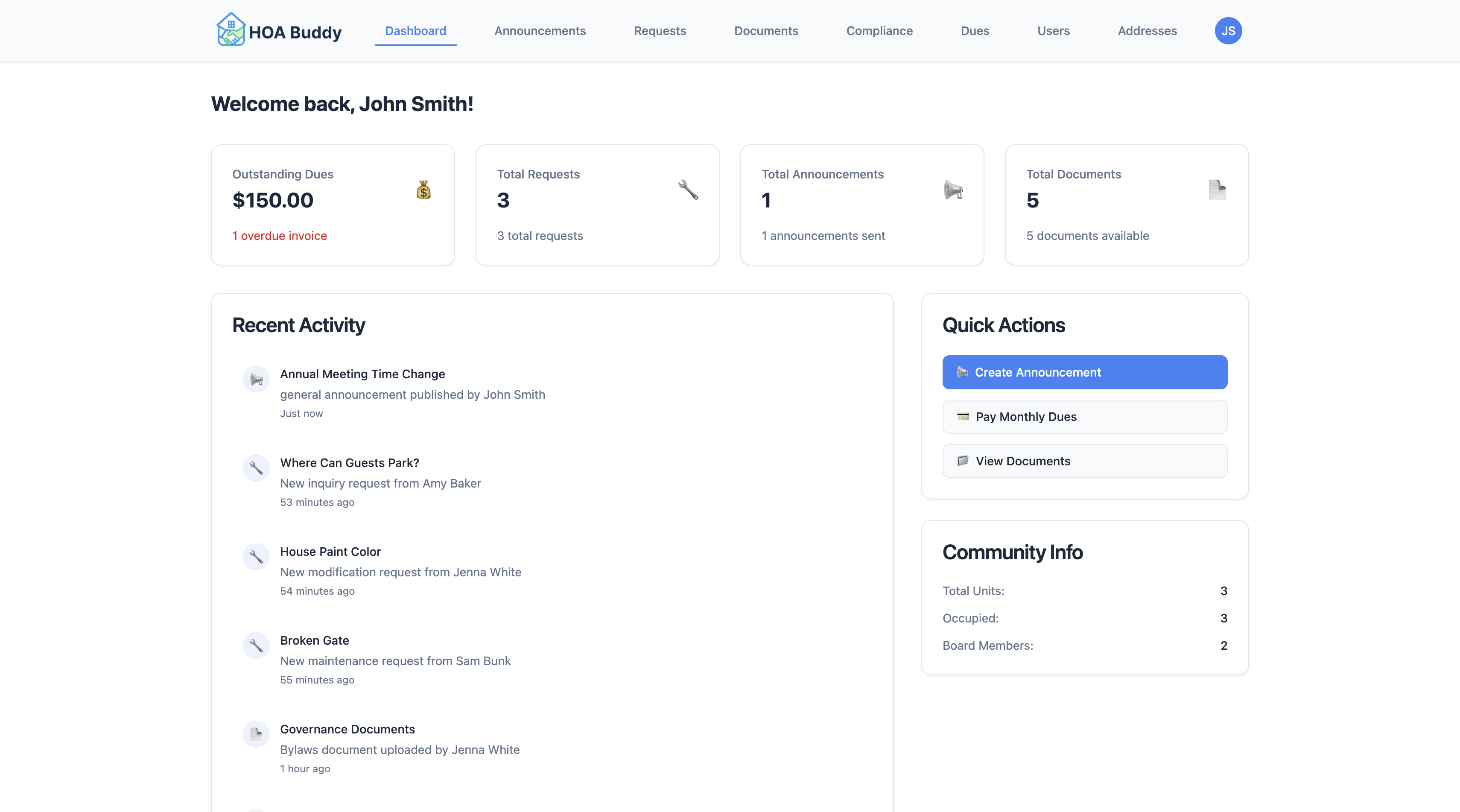
HOABuddy gives board members the operational tools they need — dues collection, maintenance request tracking, violation management, document storage, and communication — so they can focus on governance rather than administrative overhead. Start a free 30-day trial.
Ready to simplify HOA management?
HOABuddy handles dues collection, resident communication, maintenance tracking, and more — free for 30 days.
Start Free TrialLearn more about HOA Board Software →