
5 Common HOA Communication Problems (and How to Solve Them)
Most HOA disputes start with a communication breakdown, not a rule violation. Here are the five most common problems board members face — and practical fixes for each.
Most HOA conflicts don't start with a rule violation. They start with a resident who didn't know about a policy change, a maintenance request that was never acknowledged, or a dues notice that arrived without any explanation. Communication failures are the root cause of a surprisingly large share of the disputes, board resignations, and legal headaches that HOA boards face.
Here are the five most common HOA communication problems — and what boards can do to fix them.
1. Announcements That Don't Reach Everyone
The board posts a notice about an upcoming road closure. Half the community finds out the night before. The other half finds out when they're sitting in their car unable to leave their driveway.
The typical culprit is a fragmented communication stack: some residents are on email lists, some follow a Facebook group, some only check physical bulletin boards. No single channel reaches everyone, and the board doesn't have a reliable way to confirm who actually received what.
What to do:
- Establish one primary communication channel and train residents to rely on it. A community-wide digital announcement system beats Facebook groups because you control the distribution and have a record of what was sent.
- For time-sensitive notices (road work, water shutoffs, emergency repairs), send via every channel simultaneously rather than choosing one.
- Keep an updated contact list with email addresses for every unit. Outdated contact info is one of the most common reasons notices fail to land.
- Send announcements at least 48–72 hours in advance for routine matters and immediately for emergencies.
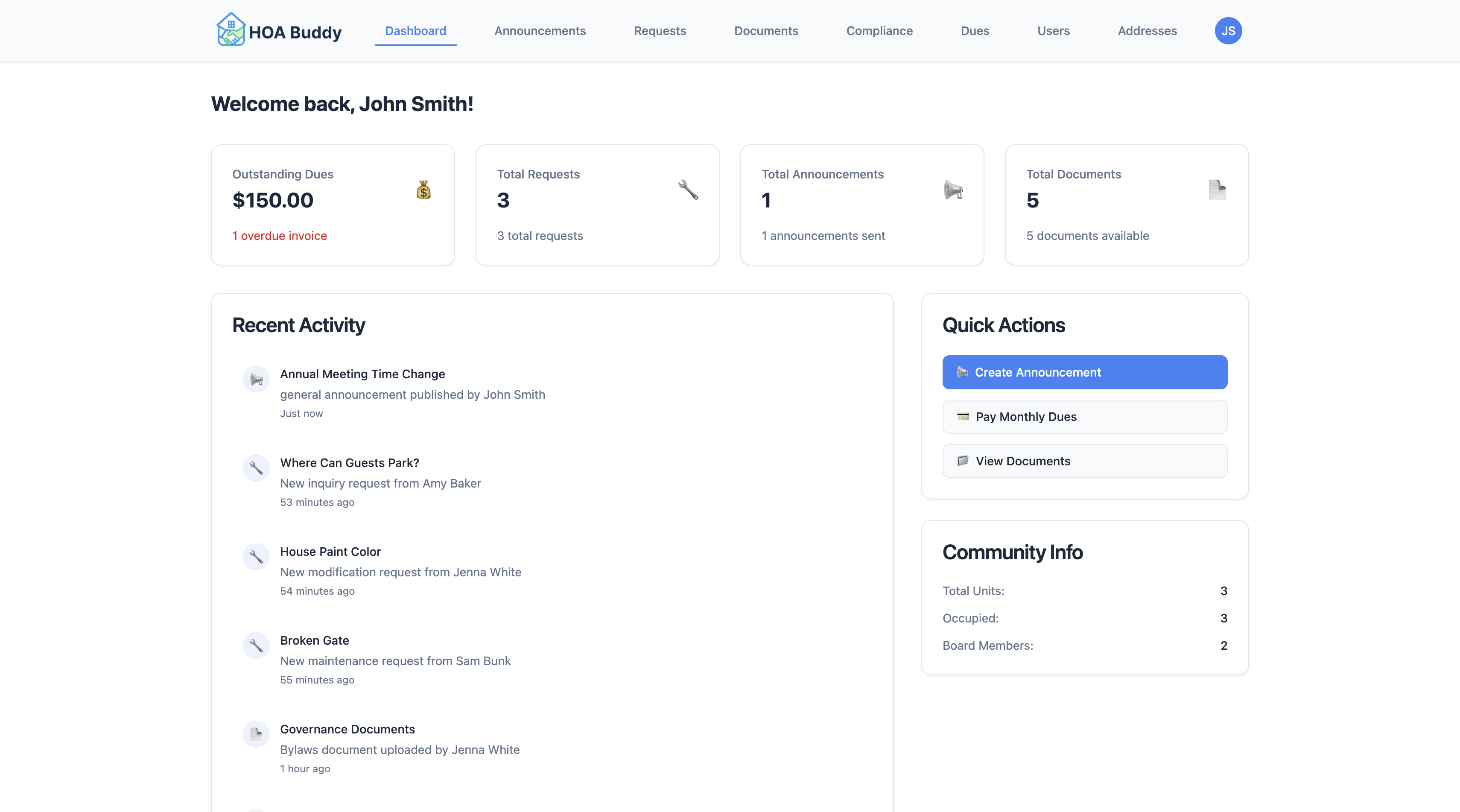
HOABuddy's announcements feature lets board members post community-wide notices that go to all residents at once, with a permanent record accessible to anyone who joins the community later.
2. Violation Notices That Feel Like Attacks
Violation management is one of the most contentious areas of HOA administration. A notice that reads like an accusation — even when it's technically correct — puts residents on the defensive, invites pushback, and sometimes escalates into a formal dispute that consumes hours of board time.
The problem usually isn't the rule being enforced; it's the tone and consistency of enforcement.
What to do:
- Use a standard template for all violation notices. Consistency signals that enforcement is rule-based, not personal. When one resident gets a formal written notice and another gets an informal verbal warning for the same offense, it creates the perception of favoritism.
- Lead with the rule, not the accusation. "Section 4.2 of the CC&Rs requires all vehicles to be parked in the garage or driveway between 10 PM and 6 AM" lands differently than "your car was blocking the street again."
- Always include a clear path to resolution: what the resident needs to do, by when, and how to communicate back to the board if they need more time or have a question.
- Document every notice sent, every response received, and every follow-up. Gaps in the paper trail are where disputes get ugly.
HOABuddy's violation tracking keeps a full history of every notice, resident response, and board follow-up in one place — so nothing gets lost and enforcement stays consistent across board members and across time.
3. Maintenance Requests That Disappear
A resident submits a request to fix a broken gate. Nothing happens for three weeks. They submit it again. Nothing. They post in the neighborhood Facebook group. Now it's a community grievance.
The issue is almost never that the board doesn't care — it's that requests submitted by email or verbal conversation have no reliable tracking, and things fall through the cracks when the board member who received the request is traveling or steps down.
What to do:
- Give every maintenance request a tracking number or written confirmation. Residents who receive acknowledgment are far more patient than residents who don't know if anyone saw their message.
- Set realistic response time expectations and communicate them publicly. "We aim to respond to all maintenance requests within 5 business days" is better than silence — even if the actual fix takes weeks.
- Route all requests through one channel rather than individual board members' personal email inboxes. When a request lives in one person's inbox, it can only be acted on by that person.
- Close the loop. When a repair is completed, notify the resident who submitted the request. It costs almost nothing and signals that the community is being taken care of.
HOABuddy's maintenance request system lets residents submit requests through a shared queue, with message threads that keep the conversation between the board and the resident in one place — no more hunting through email chains to reconstruct what happened.
4. Important Documents Buried in Email or Lost in Transition
"Where are the CC&Rs?" "Can you send me last year's budget?" "What was the vote count from the June meeting?"
If answering these questions requires digging through email archives or contacting the former treasurer, you have a document accessibility problem. This is especially acute during board transitions, when incoming members inherit incomplete records and outgoing members take institutional knowledge with them.
What to do:
- Maintain a central, accessible document repository for governing documents (CC&Rs, bylaws, rules and regulations), meeting minutes, annual budgets, reserve studies, and vendor contracts. The repository should be accessible to residents for documents they're entitled to see and to board members for everything else.
- Establish naming conventions and folder structure before the pile grows too large to organize. "2026-05 Board Meeting Minutes.pdf" is more findable than "Minutes — final (2).pdf."
- As part of every board transition, require outgoing members to verify that all relevant documents are in the shared repository before they step down. Don't let document handoff be optional.
- Review document retention requirements for your state. Some states specify how long meeting minutes, financial records, and other HOA documents must be kept.
HOABuddy's document storage gives board members a shared repository for HOA files, keeping everything accessible and organized without relying on any one person's email account.
5. Dues Confusion and Payment Disputes
"I didn't know my dues went up." "I paid — why does it show as overdue?" "Nobody told me about the special assessment."
Financial communication failures are expensive. They create collection headaches, damage relationships with otherwise cooperative residents, and occasionally turn into legal disputes over amounts that would have been paid willingly if the communication had been clearer.
What to do:
- Send dues increase notices well in advance — 30 to 60 days before the new amount takes effect. Include the reason for the increase. Residents who understand that the increase funds a specific repair or reserve shortfall are more likely to accept it than residents who just see a higher number.
- When an invoice is generated, it should include exactly what it's for, the due date, and the payment method. Ambiguity is the enemy of on-time payment.
- Send a reminder before the due date — not just a late notice after. A well-timed reminder eliminates most late payments without any collections process.
- Maintain a clear record of every payment received, so disputes can be resolved in minutes with documentation rather than reconstructed from memory.
HOABuddy automates dues invoicing and tracks payment status for every resident, with automatic reminders before due dates and overdue notices when payments lapse — so the board spends less time chasing dues and more time running the community.
Most of the communication problems that make HOA board service frustrating are solvable with better systems and clearer processes — not more rules or harsher enforcement. Getting the basics right (consistent notices, reliable tracking, organized records, transparent financials) removes the friction that turns minor issues into prolonged disputes.
HOABuddy gives boards the tools to handle all of it in one place: announcements, violation tracking, maintenance requests, document storage, and automated dues collection. Start a free 30-day trial.
Ready to simplify HOA management?
HOABuddy handles dues collection, resident communication, maintenance tracking, and more — free for 30 days.
Start Free TrialLearn more about Resident Communication Software →