
HOA Dues Collection: The Complete Board Member's Guide
Everything HOA board members need to know about dues collection — setting policy, running the collection process, handling delinquencies, and when to escalate.
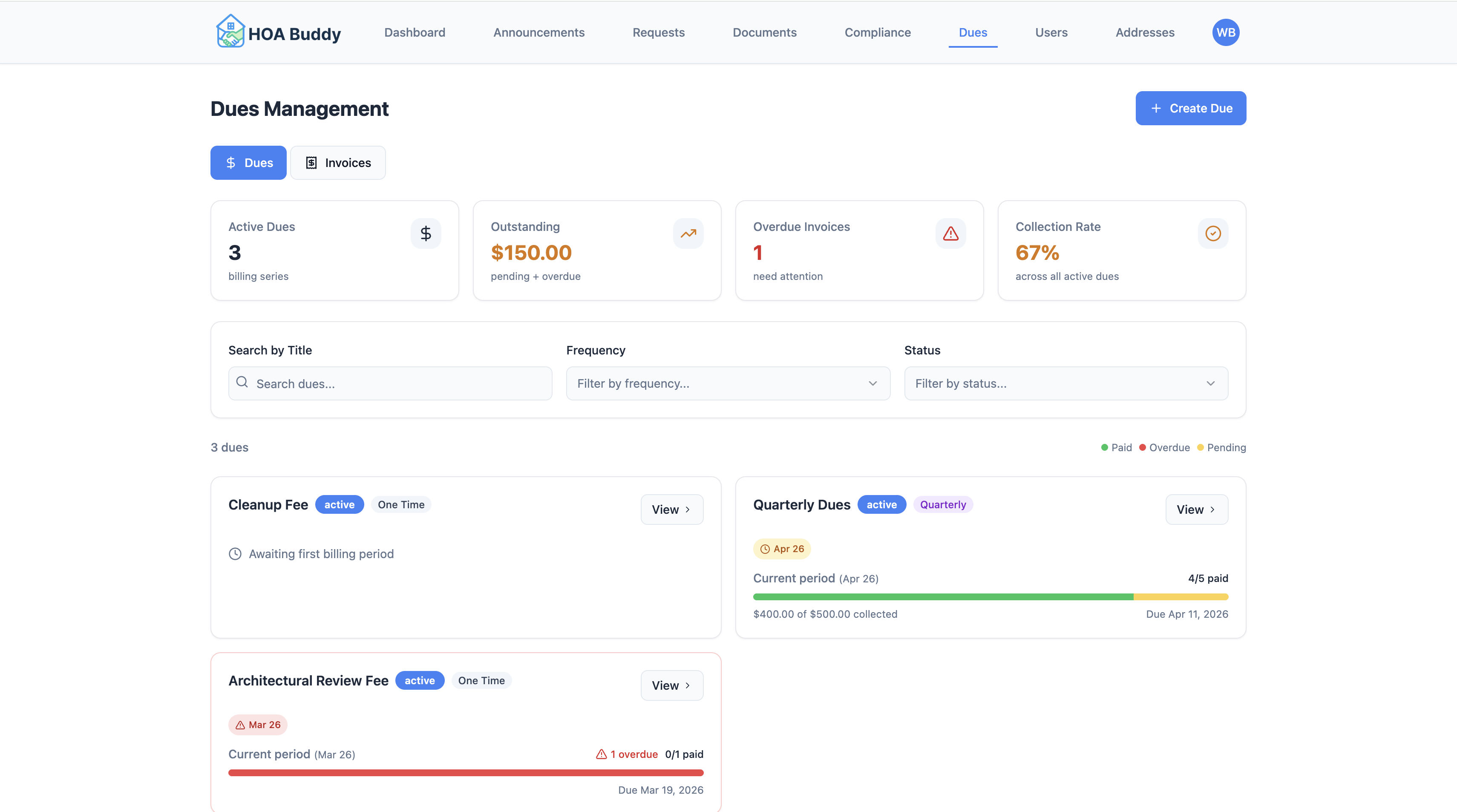
Dues collection is the financial engine of every homeowners association. Without reliable cash flow, the HOA can't pay for landscaping, utilities, insurance, or reserve contributions — and those shortfalls eventually show up as special assessments that surprise and frustrate residents.
Most collection problems aren't caused by bad intentions. They come from unclear policies, inconsistent enforcement, and processes that make paying inconvenient. This guide walks through the entire dues collection framework — from setting policy to handling delinquencies — so your board has a clear, defensible process from day one.
What HOA Dues Cover
HOA dues fund two distinct buckets:
Operating expenses are the predictable, recurring costs of running the community: landscaping, utilities for common areas, insurance, management fees, and minor maintenance. These should be predictable enough to budget line by line.
Reserve contributions fund future capital expenditures — roof replacements, repaving, pool equipment, elevator maintenance. A reserve study projects the cost and timeline for every major system in the community, and your dues should fund those contributions on schedule. Under-funded reserves are one of the leading causes of special assessments.
When setting dues amounts, work backward from your approved annual budget. Add the operating budget to the year's reserve contribution target, divide by the number of units, and that's your baseline. Most HOA advisors recommend reserves be funded to at least 70% of projected replacement cost. Going below that creates risk; going to 100% provides the most protection.
Building a Collection Policy
Before you collect a single payment, you need a written, board-approved collection policy. Without one, every delinquency becomes a negotiation, and inconsistent treatment exposes the HOA to discrimination claims.
A solid collection policy specifies:
- Due date — the date each assessment is owed (typically the 1st of the month or quarter)
- Grace period — the window after the due date before late fees begin (10–15 days is standard)
- Late fee — a flat dollar amount or percentage; check your state's statutory limit
- Escalation timeline — at what point the account moves from reminder to formal demand, and from formal demand to lien or legal referral
- Accepted payment methods — check, ACH, credit card, or a combination
- Partial payment policy — whether partial payments are accepted and how they're applied
- Payment plan criteria — under what circumstances the board will approve a payment plan, and on what terms
- Hardship provisions — how residents experiencing temporary financial difficulty can request relief
The policy should be distributed to every resident and available in your community portal. New residents should receive it at closing or move-in. When the policy is clear, late-fee disputes mostly disappear — the resident signed the policy and can look it up themselves.
A note on state law: HOA collection requirements vary significantly by state. Many states cap late fees, set minimum notice periods before lien filings, and regulate the lien process itself. Your collection policy must comply with the laws of your state. Have an HOA attorney review the policy before you adopt it.
The Collection Process, Step by Step
A well-designed collection process does most of the work before the board ever has to get involved personally.
1. Invoice Generation
Every resident with an active due should receive an invoice at the start of each billing period. The invoice should show:
- Amount due and due date
- Payment method options (with a direct link if you accept online payment)
- Account balance if there is a prior outstanding amount
- Contact information for questions
Recurring dues — monthly assessments, quarterly fees — should be generated automatically. Setting this up once and letting the system run eliminates the manual work of generating invoices each cycle and removes the risk of a billing period being missed.
2. Pre-Due Reminders
A reminder 5–7 days before the due date catches residents who need a nudge. Keep it friendly and short: amount due, due date, payment link. This single touch reduces late payments meaningfully without any manual effort from the board.
3. Due Date
On the due date, unpaid accounts move to the grace period. No action is usually needed on the due date itself — let the grace period run its course before triggering late fees.
4. Grace Period and Late Fee Application
When the grace period expires, the late fee applies automatically to any unpaid balance. The system should update the account balance immediately and send a notice to the resident that the fee has been applied.
5. Post-Due Reminders (30/60/90 Days)
Accounts that remain unpaid after the grace period need a structured reminder schedule:
- 15–30 days past due: Friendly reminder that the account is overdue, balance due including late fee, payment link
- 30–60 days past due: Firmer notice that the account will be referred per the collection policy if not resolved
- 60–90 days past due: Final notice before formal collection action, noting specific next steps (formal demand letter, lien filing)
Most residents who pay late without these reminders would have paid on time with them. The minority who don't respond after 60 days are genuine delinquencies that need escalation.
Handling Delinquencies
Once an account reaches 60–90 days past due with no response, the board should move to formal collection steps. The threshold is defined in your collection policy — follow it consistently.
Formal Demand Letter
A formal demand letter is the first step in the legal collection process. It documents that the HOA has made a written demand for payment and establishes the timeline before legal action. Many HOA attorneys provide demand letter services; the cost is typically recoverable from the delinquent owner under the CC&Rs.
Payment Plans
Before escalating to a lien, consider whether a payment plan is appropriate. Some boards are reluctant to offer payment plans because they feel like leniency — but a structured payment plan that brings the account current over 3–6 months is often better for the HOA's cash flow than a lien that may take a year or more to resolve.
The collection policy should define the criteria for approving a plan (first-time delinquency, genuine financial hardship, etc.) and the terms (minimum monthly payment, what happens if the plan is broken).
HOA Liens
If a payment plan isn't agreed to or is broken, the HOA's most powerful collection tool is the lien. An HOA lien is recorded against the property title, which prevents the owner from selling or refinancing without first satisfying the debt.
The lien process is governed by state law and your governing documents. In most states it requires:
- Recording the lien with the county recorder after proper notice to the owner
- Waiting a statutory period before foreclosing on the lien
- A separate court action or non-judicial process to actually foreclose
Lien filing is a legal process. Errors in notice, timing, or documentation can invalidate the lien or expose the HOA to liability. Use a licensed HOA attorney for lien filings — this is not a task for the board to handle directly.
Collections Attorney Referral
For accounts that continue to age without resolution, referral to an HOA collections attorney is the appropriate step. The attorney can handle formal demand, lien filing, foreclosure proceedings, and potentially small claims court for smaller balances.
Many HOA attorneys work on a contingency or cost-recovery basis for collection matters, meaning their fees are added to the delinquent balance rather than paid out of pocket by the HOA.
How Software Reduces the Manual Burden
The collection process above sounds like a lot of work — and it is, if you're doing it manually. Modern HOA software automates most of the repetitive steps.
With the right tools, the board sets up the dues structure once (amount, frequency, recipients) and the software handles:
- Invoice generation on schedule each billing period
- Pre-due and post-due reminders at configured intervals
- Late fee application when the grace period expires
- Delinquency dashboard showing every account's current status, days overdue, and balance
The board only needs to get personally involved when an account reaches the formal escalation threshold. Everything before that is automated.
HOABuddy's dues module handles this full cycle: recurring invoice generation, online payment via Stripe Checkout (residents pay by card or ACH directly to the HOA's connected account), automated overdue notifications when invoices go past due, and a collection dashboard for the Treasurer showing real-time collection rate and overdue accounts. For a deeper look at modernizing the payment and automation side, see How to Streamline HOA Dues Collection.
For lien filings and legal escalation, you'll need an HOA attorney — that's outside the scope of software tools and requires a licensed professional in your state.
Frequently Asked Questions
What happens if a homeowner doesn't pay HOA dues?
Unpaid dues typically result in late fees, formal demand letters, and eventually a lien recorded against the property. A lien prevents the owner from selling or refinancing until the debt is paid. In more severe cases, the HOA can foreclose on the lien, though this is a last resort and governed by state law.
Can an HOA put a lien on my property for unpaid dues?
Yes, in most states HOAs have the legal authority to record a lien against a property for unpaid assessments. The process — notice requirements, amounts, and timing — varies by state and by your HOA's governing documents. A lien is typically filed after 60–90 days of non-payment following proper notice.
How do I set up online dues payment for my HOA?
The most reliable approach is a payment processor that supports direct deposit to the HOA's bank account and provides automatic receipts and transaction records. HOABuddy uses Stripe Checkout: residents pay by card or ACH, the full invoice amount deposits directly to the HOA's Stripe-connected account, and a small processing fee is added to the resident's payment rather than deducted from the HOA's proceeds.
What late fee can an HOA charge?
Late fee limits vary by state. Some states cap HOA late fees at a flat dollar amount (e.g., $25); others allow a percentage of the overdue balance. Your collection policy must comply with your state's limit. If you're unsure, have an HOA attorney confirm the allowable fee before adopting your policy.
Can an HOA waive late fees?
Yes, and boards sometimes do so for a first-time late payment or documented hardship. The key is that any waiver should go through a consistent, documented process — not an informal decision by one board member. Document waiver decisions in board meeting minutes so there's a record of consistent treatment across residents.
How often should HOA dues be collected?
Most HOAs collect monthly or quarterly. Monthly collection provides more predictable cash flow and smaller per-payment amounts that are easier for residents to budget. Quarterly collection reduces administrative overhead but creates larger lump-sum payments. Annual collection is less common and creates significant cash flow risk if a meaningful number of owners are delinquent.
A well-run dues collection process starts with a clear policy, uses automation to handle the routine steps, and reserves board time for the decisions that actually require human judgment. Get the policy and the tooling right once, and most months the process runs itself.
Ready to simplify HOA management?
HOABuddy handles dues collection, resident communication, maintenance tracking, and more — free for 30 days.
Start Free TrialLearn more about HOA Dues Collection Software →